Sustainable Architecture in Madagascar: Combining Prestige and Performance
PRESTIGE ARCHITECTURE · PERFORMANCE & SUSTAINABILITY
By the Prisme Editorial Team | March 24, 2026 | Reading time: 12 minutes
In Madagascar, building with prestige means seizing one of the most dynamic real estate opportunities in the region. It also means designing intelligently, taking advantage of exceptional sunshine, generous rainfall, and an energy context rapidly evolving toward renewables. Discover how Prisme, the reference firm on the Red Island, transforms every local specificity into a sustainable competitive advantage.
Table of Contents
- The Malagasy Context: Why Energy Performance is a Strategic Lever
- Bioclimatic Design According to Prisme: Architecture as the First Energy Saving
- Energy Systems Engineering: Produce, Store, and Manage with Complete Autonomy
- Smart Building Systems and Prisme's Digital Engineering
- Environmental Engineering and Sustainable Water Management
- Materials, Quality Construction, and Asset Value Enhancement
- Frequently Asked Questions
You have signed the plans. The project is taking shape. What if, from this stage, every architectural decision was already designed to optimize energy consumption, guarantee building autonomy, and maximize your investment value over 30 years? The energy design of a prestige building is not a technical detail to be addressed at the end of the project; it is a fundamental strategic decision made from the sketch phase.
In Madagascar, a territory of exceptional natural wealth and real estate potential, architectural design takes advantage of remarkable climatic specificities. Sunshine among the most generous in the region, abundant rainfall over a large part of the island, and a national energy context rapidly evolving toward renewables: these are all assets that Prisme integrates from the design phase to create high-performance, autonomous, and sustainably valued buildings.
It is precisely to respond to these documented and concrete local realities that Prisme has structured its expertise around an integrated approach we call the Quintile Firm, a global engineering approach that brings together, within a single entity, prestige architecture, building engineering, environmental engineering, digital engineering, and performance management throughout the entire lifecycle. This is not just another service provider. It is a new way of designing, building, and guaranteeing excellence.
1. The Malagasy Context: Why Energy Performance is a Strategic Lever {#context}
In Madagascar, as elsewhere in the world, the most successful prestige real estate projects are those that integrate energy performance from the very first design phase. Designing intelligently from the sketch stage means maximizing comfort, reducing operating costs, and sustainably enhancing the asset's value. This is exactly what Prisme offers.
Energy Autonomy: A Major Competitive Advantage
Madagascar aims to achieve 80% renewable energy in its national mix by 2030, a strong signal of an energy market in full transformation. In this dynamic context, designing a prestige building with its own energy production and storage capacity means ensuring total autonomy, controlled operating costs, and a premium position in a rapidly structuring real estate market.
Prisme designs every prestige residential or commercial project with a native hybrid energy system, integrated from the sketch phase, not added along the way. Energy autonomy is not a premium option at Prisme: it is a delivery condition.
An Exceptional Territory with Remarkable Climatic Assets
Madagascar benefits from a privileged geographical position in the Indian Ocean, with exceptional sunshine and incomparable natural resources. Its tropical climate involves a cyclone season from November to April, well documented and perfectly predictable with adapted engineering. Climate projections indicate a temperature increase of 1.1 to 2.6 °C by 2065, a global trend that reinforces the value of intelligent bioclimatic architecture worldwide.
| Indicator | Data | Source |
|---|---|---|
| 80% renewable energy target | National goal 2030 | Malagasy energy policy |
| 2,800 h average annual sunshine | Among the best in the region | World Bank |
| +2.6 °C projected temperature increase | By 2065 | DGM / World Bank |
| 20-35% additional value | For certified sustainable assets | Market studies |
These indicators outline a real estate market in full structuring, where sustainable and autonomous architecture constitutes a documented competitive advantage as well as a common-sense choice. Prisme integrates them into its calculations from the first design phase, so that each project is sized according to tomorrow's realities.
2. Bioclimatic Design According to Prisme: Architecture as the First Energy Saving {#bioclimatic}
Energy performance does not begin with solar panels or technical equipment. It begins with building orientation, window placement, thermal mass management, and natural ventilation. At Prisme, this principle is not a theoretical ideal: it is a systematic working method, applied from the first week of design.
Bioclimatic Siting and Orientation Adapted to the Malagasy Climate
Madagascar has very distinct microclimates depending on the region:
- The Central Highlands (Antananarivo): cool nights year-round, hot days in the dry season, daily temperature ranges exceeding 15 °C
- The East Coast: over 3,000 mm of annual rainfall, diffuse sunshine
- The West Coast: more arid, exposed to dominant warm winds
Each of these contexts requires a different bioclimatic response. Prisme's engineers systematically analyze site weather data before any siting decisions. Optimized building orientation, strategic placement of glazed surfaces, and thermal mass design allow, in Madagascar, a 25 to 35% reduction in air conditioning needs compared to standard design, without any additional equipment. This gain is permanently secured from the sketch phase.
At Prisme, every prestige project undergoes a site bioclimatic analysis including:
- Sunshine surveys
- Dominant wind studies
- Seasonal rainfall studies
- Shade pattern simulations
This step, integrated into our standard process, is what enables the design of comfortable buildings without excessive air conditioning, high-performance buildings without over-equipment.
Solar Protection, Cross Ventilation, and Tropical Comfort
In a tropical country like Madagascar, solar management is the central parameter of interior comfort and energy efficiency. Prisme sizes each solar protection device by calculation, not approximation:
- Generous roof overhangs
- Adjustable sunshades
- Vegetated pergolas
- Facade-specific solar control glazing
The goal is a precise balance between generous natural light and effective thermal protection, two requirements often presented as contradictory that our engineering reconciles.
Cross ventilation, integrated into space layout, ensures:
- Permanent passive cooling during the hot season
- Naturally renewed air quality
- Direct reduction of air conditioning loads
These combined passive strategies form the foundation upon which the entire technical strategy of the building is built, and it is precisely their execution quality that distinguishes a Prisme residence from an ordinary one.
3. Energy Systems Engineering: Produce, Store, and Manage with Complete Autonomy {#systems}
Once bioclimatic design is established, Prisme sizes the active energy systems that complement and amplify passive gains. In the Malagasy context, these systems provide a decisive additional value: guaranteeing service continuity and complete energy autonomy for the building, regardless of grid evolution.
Integrated Photovoltaics, Storage, and Total Energy Autonomy
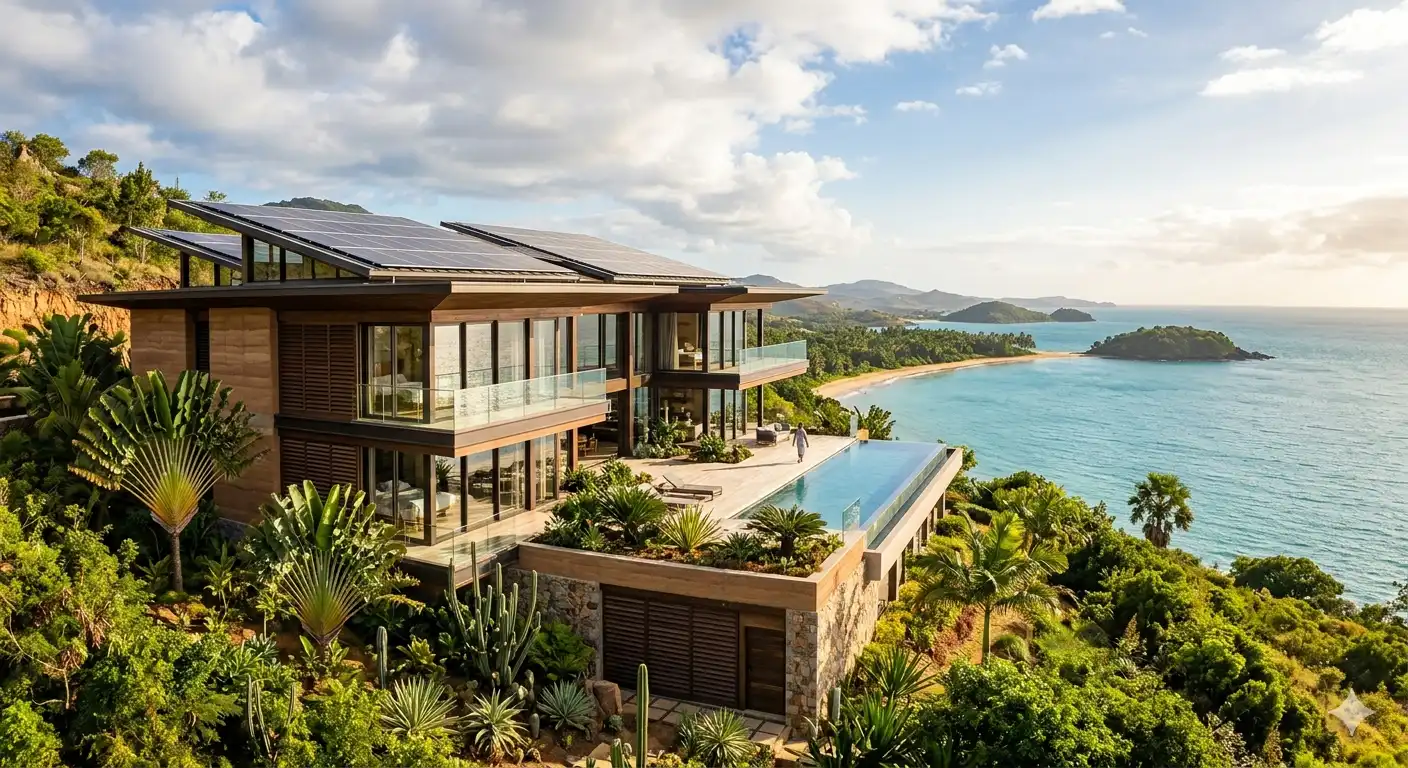
Photovoltaic panels integrated into roofs and facades, combined with lithium battery storage systems sized for 24 to 72 hours of autonomy depending on needs, allow a prestige residence or office building designed by Prisme to operate with complete peace of mind. This level of energy autonomy is today one of the strongest arguments for enhancing the value of a prestige real estate asset in Madagascar.
The architectural integration of these systems is carefully controlled by Prisme: no poorly oriented panels, no visible cabling, no installation that betrays a last-minute addition. Technology becomes an aesthetic asset, a discreet sign of engineering excellence that enhances the entire project.
Heat Pumps, Solar Thermal, and Intelligent Energy Management
High-performance heat pumps provide heating and cooling with coefficients of performance (COP) three to five times higher than traditional electric systems, significantly reducing consumption.
Solar thermal systems, in a country that benefits from excellent average sunshine of 2,000 to 2,800 hours per year, cover up to 80% of domestic hot water needs.
For reference: for a 450 m² prestige residence in the Highlands, the combination of bioclimatic design + photovoltaics + storage + heat pump reduces grid consumption by 70 to 80%, while maintaining constant thermal comfort and complete energy autonomy.
Toward Autonomous and Resilient Buildings
The most ambitious projects that Prisme supports aim for overall optimization of the energy balance:
- Need reduction through bioclimatic architecture
- Local production through photovoltaics
- Storage for nighttime autonomy and service continuity
- Heat recovery through heat pumps
This systemic approach transforms the building into an energy-independent asset, capable of maintaining optimal comfort in all circumstances. This energy autonomy is today one of the strongest arguments for enhancing the value of a prestige real estate asset.
4. Smart Building Systems and Prisme's Digital Engineering {#smart}
The digital transformation of buildings represents a full-fledged dimension of architectural excellence today. At Prisme, digital tools are not technological gadgets presented at delivery: they are engineering instruments integrated from the design phase, enabling performance optimization before the first wall is even built.
BIM and Thermal Simulation: No Surprises at Delivery
Prisme models all its projects in BIM (Building Information Modeling) , a three-dimensional parametric digital model that simultaneously integrates building geometry, materials, technical systems, and energy performance. Each modification scenario (window orientation, insulation thickness, glazing type) is analyzed in real time for its energy, structural, and budgetary consequences.
Dynamic thermal simulation software anticipates building thermal behavior for every hour of the year, under the specific climatic conditions of its Malagasy site. This modeling precision guarantees that announced design performances match actual delivery performances.
Intelligent Energy Flow Management
Once the building is delivered, the technical management systems (BMS) installed by Prisme enable real-time control of all equipment: air conditioning, lighting, solar production, battery storage level, water consumption.
Machine learning algorithms analyze occupant habits, weather forecasts, and energy production data to optimize every decision automatically.
Residents or asset managers have access to a dashboard accessible via smartphone or tablet, visualizing in real time energy performance, savings achieved, and maintenance alerts, even from abroad.
4D Simulation and Digital Twins
For large-scale projects, Prisme develops digital twins that simulate not only space and energy performance, but also building evolution over time: material aging, predictive maintenance needs, renovation scenarios. This predictive engineering transforms the management of a prestige real estate asset into a proactive, planned, and financially controlled approach throughout the building's life.
5. Environmental Engineering and Sustainable Water Management {#water}
Madagascar is an island generous in water resources, with annual rainfall among the highest in the region for a large part of the territory. Managing this resource well from the building design phase means turning it into an advantage: reduced operating costs, independence from the grid, optimal comfort in all seasons. Prisme makes this a structuring dimension of every project.
Integrated Water Cycle Management
Prisme integrates a comprehensive water cycle approach into each project:
- Rainwater collection and storage
- Filtration and treatment systems adapted to uses (irrigation, toilets, pools, sanitary water)
- Low-consumption equipment selected from the specification phase
In a country with annual rainfall ranging from 300 mm in the South to over 3,000 mm in the East, rainwater harvesting engineering represents a major lever for water autonomy.
Prisme-sized recovery systems cover up to 60% of domestic non-potable water needs. For prestige residences with gardens and pools, these systems represent substantial and recurring savings, while reinforcing overall building autonomy.
Climate Resilience: Precision Engineering
The cyclone season is part of the Malagasy calendar, well known and documented. Prisme integrates it as one engineering parameter among others:
- Stormwater network design
- Site drainage
- Roof and structure sizing according to Malagasy cyclone standards
Mastering these parameters with precision guarantees a building that lasts for decades without surprises.
Biodiversity, Outdoor Spaces, and Air Quality
Prestige residences designed by Prisme integrate landscape design in direct synergy with building engineering:
- Vegetated roofs
- Bioclimatic gardens showcasing endemic Malagasy species
- Landscape swales for stormwater management
These devices contribute to building thermal regulation, natural management of cyclone runoff, and enhancement of local biodiversity. They also create exceptional outdoor spaces, authentically Malagasy, that become the signature of each project.
Finally, indoor air quality receives particular attention at Prisme:
- Selection of low-VOC emission materials
- Double-flow controlled mechanical ventilation systems with heat recovery
- Integration of indoor vegetation
These devices create a healthy, comfortable indoor environment that meets the standards of the best international residences.
6. Materials, Quality Construction, and Asset Value Enhancement {#materials}
Material selection in Madagascar is a strategic decision in its own right. The island has a rich local industry, and mastery of supply, whether local or imported, directly conditions execution quality, timelines, and budget adherence. Prisme makes this expertise a concrete advantage for each client.
Quality Local Sourcing, Valued by Prisme
Madagascar has an exceptional palette of local construction materials with remarkable qualities:
- Laterite for foundations
- Certified teak wood for structures and joinery
- Volcanic dimension stone for cladding
- Stabilized rammed earth for high thermal inertia walls
Prisme systematically values these local resources when they meet project performance and durability requirements, reducing import costs, supply lead times, and carbon footprint while creating architecture authentically Malagasy, rooted in its territory.
Thermal Envelope and Air Tightness: The Invisible That Decides Everything
A building's energy performance largely depends on details invisible to the naked eye once construction is complete:
- Thermal bridge treatment
- Roof and wall insulation quality
- Envelope air tightness
These elements, executed with rigor, ensure that designed performances are fully realized at delivery. Prisme supervises these steps with millimeter precision, relying on systematic quality control protocols and instrumented verifications during construction.
Sustainability as the New Standard of Luxury in Madagascar
The prestige real estate market in Madagascar, particularly in Antananarivo, Nosy Be, and premium coastal destinations, is experiencing favorable dynamics in 2026, driven by growing international demand. In this structuring market, sustainable, certified, and high-performance assets clearly differentiate themselves from standard assets, both in rental attractiveness and resale value.
Prisme accompanies its clients toward the most recognized international certifications:
- HQE (Haute Qualité Environnementale)
- BREEAM (Building Research Establishment Environmental Assessment Method)
- LEED (Leadership in Energy and Environmental Design)
These certifications, increasingly demanded by institutional investors and international companies present in Madagascar, constitute a documented value lever and a strong quality signal in a rapidly structuring real estate market.
Comparison Table: Prisme vs. Traditional Design Office
| Criteria | Traditional Design Office | Prisme — Quintile Firm |
|---|---|---|
| Energy Approach | Standard design, equipment chosen a posteriori | BIM thermal simulation from sketch phase, native bioclimatic integration |
| Energy Autonomy | Standard grid supply, no own production | Hybrid solar + storage systems designed for complete autonomy |
| Cyclone Resistance | Basic standards, little dynamic verification | Integrated cyclone engineering, wind load modeling |
| Water Management | Standard networks, no recovery | Rainwater collection, filtration, zero waste planned from design |
| Materials & Traceability | Untracked imports, variable costs | Certified local sourcing + selected imports, controlled carbon footprint |
| Indoor Air Quality | Not addressed in design phase | Integrated double-flow VMC, upstream COV material selection |
| Post-Delivery Follow-up | Nonexistent or occasional | Real-time monitoring, predictive maintenance, digital twin |
| Environmental Certification | Rarely targeted or supported | BREEAM / HQE support, alignment with international standards |
| Asset Value Enhancement | Not optimized long-term | Documented 20-35% higher value for certified sustainable assets |
Typical Scenario — Prestige Villa in the Highlands
"We never imagined that sustainable engineering could integrate so well into the project, nor generate so many savings from the first year."
Project Profile: An investor wanting to build a 600 m² prestige villa in the Malagasy Highlands, with a pool, advanced home automation, and international standard finishes. The initial budget included standard centralized air conditioning and conventional grid supply, without its own energy production.
Prisme Intervention: From the design phase, our teams proposed a bioclimatic redesign of building siting, optimized orientation of glazed surfaces, a vegetated roof with high thermal inertia, an 18 kWp photovoltaic system integrated into terrace shading structures, and 36 kWh storage providing 48 hours of complete autonomy. Rainwater recovery systems cover up to 55% of irrigation and pool needs.
Projected Results Based on Our Methodology:
- 70 to 80% reduction in grid consumption
- Complete energy autonomy maintained during grid interruptions
- Annual savings estimated between 120 and 150 million Ariary compared to the initial scenario
- An environmental certification pathway engaged from delivery, constituting a documented medium-term asset value lever
The investment premium associated with sustainable systems typically provides a return on investment between 3 and 6 years through operating savings, depending on the systems selected and initial consumption levels.
7. Frequently Asked Questions {#faq}
Q — Does energy performance really cost more in Madagascar?
The initial premium for sustainable design is real, typically between 8 and 18% of construction cost depending on the systems selected. But this question cannot be evaluated without integrating operating costs over 20 years. In a context where energy cost control is a direct value argument for investors, the return on investment for Prisme's sustainable design is typically between 3 and 6 years. Beyond that, these are recurring annual net savings throughout the building's life.
Q — Can sustainability be integrated into a project already started?
Yes, but with constraints. The later Prisme intervenes in the design process, the more passive bioclimatic optimizations are limited, as they depend on decisions made very early: orientation, space layout, envelope design. On the other hand, active system engineering (photovoltaics, storage, technical management, water recovery) can be integrated at any stage. Prisme strongly recommends intervening from the sketch phase to maximize gains.
Q — I already have a Technical Design Office, why would I need Prisme?
A traditional Technical Design Office typically intervenes on the technical system design of a project already drawn by the architect. Their role is to size equipment from a fixed architecture. Prisme functions differently: as an Architectural Firm, our engineering is present from the first architectural sketch, co-designing architecture and its performance simultaneously. This is not a duplication, but a different articulation between architecture and engineering that produces results a traditional design office cannot achieve a posteriori.
Q — Can Prisme accompany projects outside Antananarivo, in Nosy Be or on the coast?
Yes. Prisme operates throughout Madagascar. Each geographic context undergoes specific bioclimatic and environmental analysis: the constraints of Nosy Be (high tropical humidity, cyclone exposure, permanent cooling needs) are very different from those of the Highlands or the West Coast. This detailed knowledge of Malagasy microclimates is one of the fundamental competencies Prisme has developed through its projects on the island.
Q — What certifications can Prisme help obtain?
Prisme accompanies its clients toward the most recognized international environmental certifications:
- HQE (Haute Qualité Environnementale)
- BREEAM (Building Research Establishment Environmental Assessment Method)
- LEED (Leadership in Energy and Environmental Design)
These certifications, increasingly demanded by institutional investors and international companies present in Madagascar, constitute a documented value lever and a strong quality signal in a rapidly structuring real estate market.
What Engineering Builds Well, Time Confirms
Energy performance and environmental sustainability are today, in Madagascar, full-fledged levers of distinction and value enhancement. In a rapidly structuring prestige real estate market, projects that integrate these dimensions from the design phase distinguish themselves sustainably, both through their usage comfort and their attractiveness to investors and their long-term asset solidity.
Prisme has structured all its engineering around this principle. Each project is designed to last, to resist, to meet its commitments, and to enhance client investment well beyond delivery. Our Quintile Firm approach integrates architecture, building engineering, environmental engineering, digital engineering, and predictive maintenance into a coherent vision, carried by a team that knows the Malagasy context precisely.
A sustainable building in Madagascar is not a compromise made to prestige. It is its most ambitious and most sustainable form.
Your Project Deserves Engineering Worthy of It
- Bioclimatic site analysis
- Energy feasibility
- Certification support